I Didn’t Need Another Productivity App. I Needed Something That Actually Remembers
What if your system actually remembered everything you said, every commitment you made, and every decision you took? What if you could stop organizing tasks and just think out loud while everything structured itself? And what if your daily actions always stayed aligned with your bigger goals without constant effort or review?
A few months ago, I noticed something uncomfortable. I wasn’t dropping the big things. The strategy was clear, the direction made sense, and I knew what I was building. But the small things kept slipping. Follow-ups, loose ends, conversations that needed closure. Not because I didn’t care, but because there were too many moving parts running in parallel.
Work, side projects, family, health, long-term bets, everything layered on top of each other. Every tool I tried pushed me into the same loop: capture, organize, prioritize, review. Over time, it started to feel like managing the system had become the actual work.
The problem isn’t that we don’t know what to do. It’s that we lose track of what matters while doing everything else.
That frustration is what led to TrueNorth OS.
The Breaking Point: When Systems Start Slowing You Down
At a certain level of responsibility, traditional tools stop scaling. They assume you have time to organize your thoughts, review your lists, and maintain structure manually. That assumption breaks quickly when you’re operating across multiple domains.
You’re not just managing tasks anymore. You’re managing context. Conversations, decisions, people, commitments, all of it overlapping and evolving. The friction builds slowly. You forget a follow-up. You lose the thread of a discussion. You spend time reconstructing what you already knew.
Context switching is expensive. Memory loss is even more expensive.
That’s the real bottleneck.
The Shift: From Managing Tasks to Capturing Intent
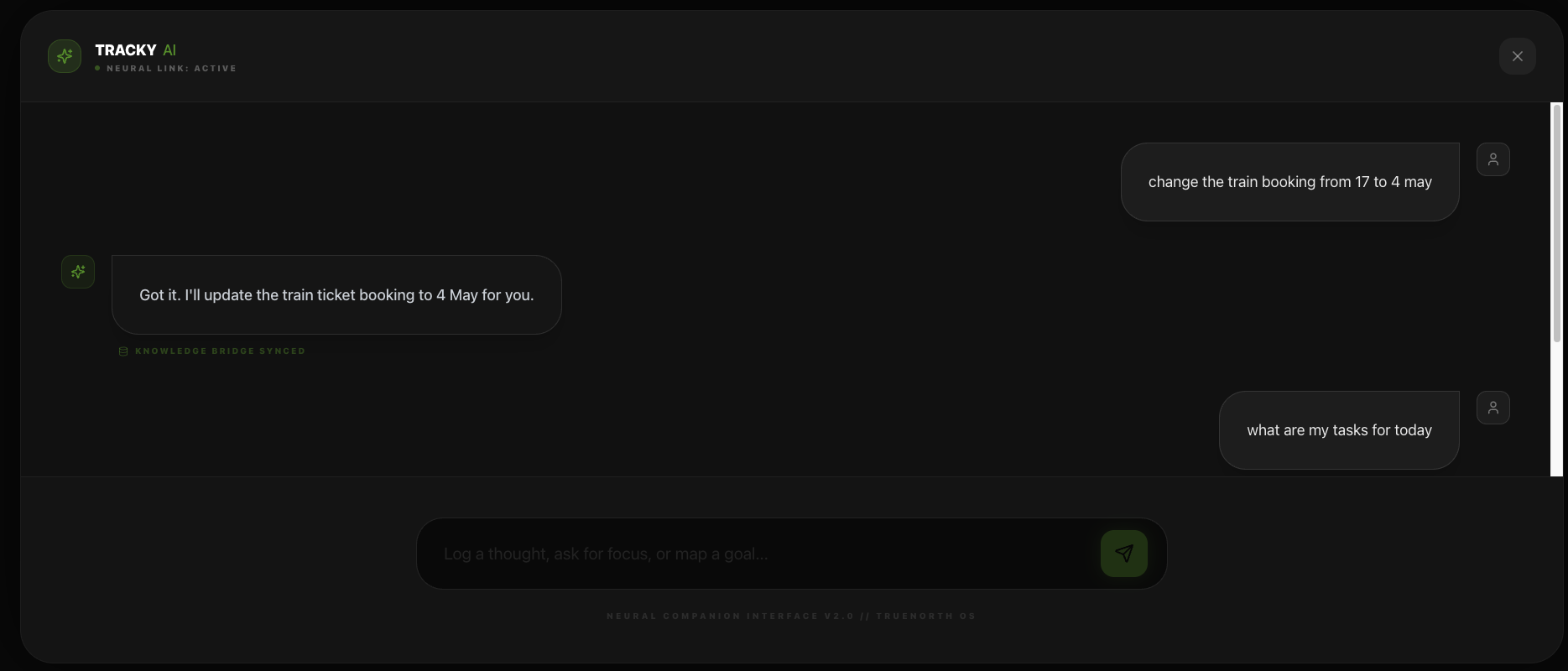
The idea behind TrueNorth was simple. Stop managing tasks. Start capturing intent.
The first time it worked, it felt almost trivial. I typed, “Need to call John tomorrow about funding.” No structure, no formatting. Just a thought.
The system handled the rest. It created a task, assigned a timeline, linked it to a person, categorized it under the right domain, and kept it active until completion.
You focus on thinking. The system handles structure.
That’s when it stopped feeling like a tool.
Seeing Your Life as a System, Not a List
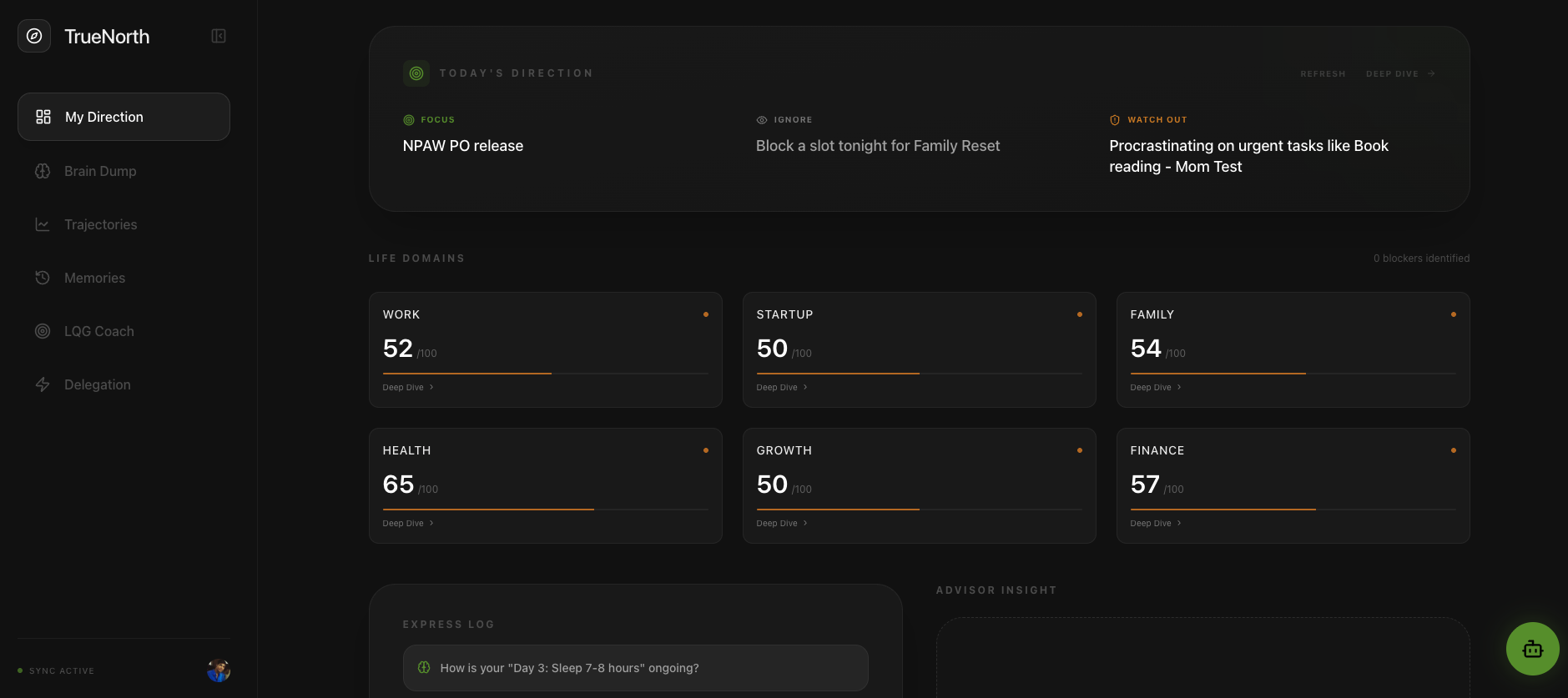
The dashboard changed how I looked at everything. Instead of a list of tasks, it showed a live state of my life.
Different domains, work, health, personal alignment, moving dynamically based on actual activity. Not what I planned, but what I actually did.
Over time, patterns became visible. A dip in health would show up before a drop in work output. Periods of focus would ripple across other areas.
“You stop guessing how you’re doing. You start seeing it.”
That visibility changes decisions.
Memory That Doesn’t Decay
Most tools forget by design. They store information, but they don’t preserve context.
TrueNorth treats every interaction as something that can matter later. Conversations are processed, compressed, and stored as structured memory. People, projects, decisions, everything becomes connected.
You don’t go searching through old notes anymore. You just recall what you need.
It feels less like searching and more like remembering.
Delegation Without the Mental Overhead
Delegation used to depend on memory. Once something was handed off, it disappeared unless you actively tracked it.
With TrueNorth, delegation stays visible. Ownership is clear. The loop remains open until it’s closed. There’s no need to mentally track who is doing what or whether something is still pending.
If it’s assigned, it’s not forgotten.
Strategy and Execution Finally Connected
One of the biggest gaps in most systems is between planning and doing. Goals sit in one place. Execution happens somewhere else. Over time, they drift apart.
TrueNorth removes that separation. You define what matters, and the system continuously aligns your daily activity against it. If something shifts, you see it immediately. If you drift, it becomes visible early.
Strategy is not something you revisit. It’s something you operate within.
Under the Hood: A System That Combines Structure and Context
What makes this work is not a single feature, but the way the system is designed underneath.
TrueNorth combines two types of memory that are usually handled separately. A graph layer stores structured relationships, things like who is working on what, how projects connect, and how responsibilities evolve. A vector layer captures meaning, allowing the system to retrieve context even when the exact wording changes.
Every input goes through an extraction process that converts plain language into structured updates. Tasks are created or closed, relationships are mapped, domain scores shift, and relevant facts are stored.
Nothing stays as raw text. Everything becomes part of a system.
The Tech Stack (For the Curious)
The system is built to balance speed, reliability, and continuous context processing:
React frontend for fast, low-friction interaction
Node and Express backend for orchestration
Firestore for real-time state management
Neo4j for relationship mapping
Qdrant for semantic memory
Local storage layer to ensure instant responsiveness
This setup allows the system to feel immediate while continuously updating in the background.
It’s designed to work every day, not just impress once.
Why This Feels Different
Most AI tools generate output. They respond to prompts. But they don’t accumulate context over time.
TrueNorth does. It builds a system around you that evolves as you use it. It remembers what matters, connects what you wouldn’t manually connect, and surfaces what needs attention without constant input.
Over time, the experience shifts. You stop managing tools and start operating within a system.
The Real Shift
At some point, productivity stops being about doing more. It becomes about not losing what already matters.
If you’ve ever felt like you’re thinking faster than your tools can keep up, or that you’re constantly juggling too many threads without a system holding them together, then you already know the problem.
You don’t need another tool. You need a system that thinks with you.
Deepak Upreti