Product Sense for Newcomers: How to Stop Building Stuff Nobody Asked For
Your boss says “improve engagement” and walks away. Panic-build a chatbot with confetti? Or slow down, ask annoying questions, and turn fog into a plan? A funny, practical guide to building product sense, the muscle behind every great product decision.
Product sense is the habit of asking "for whom, and why?" before anyone opens Figma. It is not a gift you are born with. It is a muscle, and like every muscle, it starts out weak, wobbly, and slightly embarrassing.
Here is how most of us start. Your boss walks over, coffee in hand, and says: "We need to improve engagement." Then walks away. That's it. No users, no numbers, no deadline. Just vibes.
The newcomer's instinct is to panic-build. A dark mode! A chatbot! A gamified leaderboard with confetti! Three sprints later, engagement is flat and the confetti is the only thing that moved.
People with good product sense do something less exciting and far more useful. They slow down, ask annoying questions, and narrow the fog into something solvable. The rest of this post is that process, minus the jargon, plus a few jokes to keep you awake.
Step 1: Figure out what "winning" means
Before you solve anything, pin down the goal. "Improve engagement" is a wish, not a goal. Ask what it means in plain terms: more people coming back? Longer sessions? Fewer people quitting in week one?
Think of it like a GPS. If you type "somewhere nice" into Google Maps, it will happily send you to a petrol station. You need a destination before you need a route.
Good clarifying questions sound like this:
Why does this matter to the business right now?
How will we know, in numbers, that we succeeded?
What are we not allowed to break along the way?
Yes, you will feel like a toddler asking "why?" five times. That is the job. The toddlers are onto something.
Step 2: Meet the cast (and pick your favourites)
Every product has more users than you think. Take a food delivery app. There's the hungry customer, obviously. But there's also the rider dodging traffic, the restaurant owner juggling three tablets, and the support agent who hears about every cold pizza.
List them all first. It's like writing the cast list for a sitcom: you can't plot the episode until you know who's in the room.
Then comes the hard part: pick one or two. Not all of them. A product built for everyone is a product loved by no one, a bit like a restaurant that serves sushi, pizza, and birthday cake from the same fryer.
Choose the users whose happiness moves your goal the most.
If the goal is "more repeat orders", the hungry customer probably beats the support agent. Sorry, support agent. We'll get to you next quarter. (We won't.)
Step 3: Fall in love with the problem, not your idea
This is where most newcomers skip ahead, and where the best PMs spend the most time. Go find out what genuinely annoys your chosen users. Talk to them. Watch them. Read the angry app reviews with a cup of tea and a strong stomach.
For our hungry customer, the list might look like:
"I never know if my food is 10 minutes away or 40."
"Reordering my usual takes six taps. I'm hungry, not patient."
"The fees appear at checkout like a jump scare."
Notice these are complaints, not feature requests. Users are brilliant at telling you where it hurts and terrible at prescribing the medicine.
Nobody asked Henry Ford for a car; they asked to get places faster.
Then select. You can't fix everything, so pick the problems that most affect your goal. If repeat orders are the target, the six-tap reorder pain is a juicy candidate. The jump-scare fees matter too, but maybe for a different goal.
Step 4: Brainstorm wildly, choose ruthlessly
Now, finally, you're allowed to have ideas. Go big. For the reorder problem you might come up with:
A one-tap "the usual" button on the home screen
A smart reminder at Friday 7pm, when you always order
A voice command: "Order my sad Tuesday noodles"
A subscription that just shows up with food, like a very delicious stalker
Quantity first, quality later. The weird ideas often hide the good ones.
Then put on your sensible hat and pick the one with the best return on investment: biggest impact on the goal for the least effort and risk. The one-tap button is cheap, obvious, and directly attacks the pain. The voice command is fun at parties and a nightmare to build. Choose accordingly.
The secret sauce: keep looking back at the goal
Here's the bit newcomers miss. Every time you pick something (users, problems, solutions), you check it against the goal from Step 1. It's your north star, your compass, your mum asking "and how does this help you get a job?"
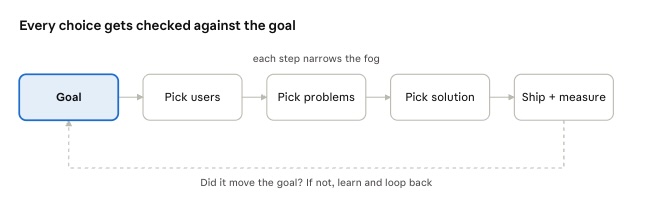
If a shiny idea doesn't move the goal, it waits, no matter how much the CEO's nephew loves it.
Then you build, ship, and measure. Did repeat orders actually go up? If yes, celebrate briefly and find the next problem. If no, congratulations: you learned something cheaply. Loop back, adjust, try again. Product sense is mostly just running this loop enough times that it becomes instinct.
How to build the muscle (without a job title)
You don't need to be a PM to practise this. You need curiosity and a slightly irritating habit of judging every app you touch.
Critique one product a week. Pick an app you use. Who is it for? What problem is it solving? What would you change, and why?
Play "design it for...". Design a fridge for students. A banking app for grandparents. A dating app for dogs. Run the five steps every time.
Ask "why?" until it hurts. When a feature launches, guess the goal behind it. Then check if you were right.
Talk to real users. Five honest conversations beat fifty assumptions in a slide deck.
Review your own misses. Every flop is tuition. Expensive tuition, but still tuition.
Quick Summary
Product sense is turning "make it better" into "help this person fix this pain, in a way that moves this number". Clarify the goal, choose your users, obsess over their problems, then pick the smartest solution.
Ship it, measure it, loop back.
Do that enough times and one day someone will say "you just have great product instincts". Smile, nod, and don't tell them it was a checklist all along.
Deepak Upreti